This is a final well done message, and a reminder about submission requirements for assignments.
Full details of your assignments and how to submit are on your Moodle areas. But here are the key links so you have them all in one email.
This is a final well done message, and a reminder about submission requirements for assignments.
EdLab Conference 24th March – 10am to 3pm
Agenda for Conference #3
10.00 Introductory Lecture: Assessment Orientations (Mark Peace and Mick Chesterman) Lecture Theatre 3
In this introductory session, we will revisit the assessment principles and requirement for the unit, and give some guidance on the kinds of forms that assessments can take.
11.00 Assignment Workshops
You will then move into your project teams, to begin to interrogate the substance, focus and form your assessment submissions will take. We want this session to give you space to actually get stuff done – so please bring along a device, and anticipate making a dent in working on your submission. Groups will report to the following rooms:
Elizabeth Gaskell’s House – BR 2.15 with John Lean
Early Years Explorers – BR 2.10 with Sean Mitchell
Environmental Play – BR 2.19 with Rachel Summerscales
The Language of Clay – BR 2.16 with Elle Simms
The Oubliette – BR 2.17 with Mark Peace
Mobilise Grimm and Co – BR 2.17 with Lauren Ash
The Game Makers – BR 2.18 with Mick Chesterman
In addition, we put on an additional workshop in BR 2.18 for students who have not engaged well enough in the process so far to feel confident in producing their assignments. It is important that you have identified yourselves to Mick Chesterman (m .chesterman @ mmu.ac.uk) ahead of the day.
13.00 Project Team Meetings / Working Lunch
The final hour of the day will be given over to project teams to continue any final development work on their planned outreach activity. Bring a packed lunch so that you can continue to work through this hour!
14.00 Ad Hoc Tutorials / Focused Session for the Students ‘Catching Up’ – 2.18/2.17
The remaining hour will be given over to allow further one-to-one support for students who need it, and for students ‘catching up’ with Mick to continue their development work.
If you do not need extra support, at this point, you are free to work independently on your assignment either in the spaces we have booked, or elsewhere.
15.00 END
Some great initial reflections on our piloting day here.
Hi all,
Just a quick blog update to document our progress at today’s piloting event! Since our last meeting with James we’ve taken time to reflect on our pressure pads and today put them under trial and error with the help of some very enthusiastic school children accompanied by their adults. Our entire team managed to make it down and I think I speak on behalf of my group when expressing my positivity towards mingling with the other groups and seeing how their mechanisms are getting along – suffice to say, very nicely!
Upon arriving, the drama studio looked ALIVE with all things Oubliette and participants started to arrive even earlier than the advised time – excited for some escape-room fun! Not just the children but their accompanying adults too, really seemed to engage and respond to each mechanism positively. The general set up of our pilot…
View original post 512 more words
Some good work on the pressure pad work here…
Taking into consideration the activities and objectives of the escape rooms, the *working* theming of the rooms are as follows: An enemy time traveller / alien (undecided) has sabotaged and destroyed the time machine engine. You are stuck in a wormhole and need to make your way through time to collect the missing engine […]

For the Tantrix room we decided that we would have a giant puzzle on the floor. Pieces will consist of triangle and square shapes in order for the puzzle to fit in the rectangle space. When all the pieces are in the correct space the pink and green line will light up showing that the […]
It is a legal requirement that anybody working with children, young people or vulnerable adults is appropriately briefed on safeguarding. As such it is important that all EdLab students engage with this post carefully.
By its very nature your work in EdLab will put you in contact with external partners and individuals outside the university – and often, these will be children and young people. Whilst you should never be put in a position by which you are responsible for a group of children, it is important that you appropriate briefed and considerate of the responsibilities this brings to you for child protection, and more broadly for ethical and professional conduct.
The term ‘safeguarding’ is used to describe the processes and measures which are put in place in order to protect children, young people and vulnerable adults. This protection includes, of course, extreme instances of abuse and maltreatment – and the current legal framework was put in place in response to highly publicised failures of public bodies to respond to warning signs that children were in danger. Safeguarding does mean something a bit broader, though. The UK Government defines the term as;
‘The process of protecting children from abuse or neglect, preventing impairment of their health and development, and ensuring they are growing up in circumstances consistent with the provision of safe and effective care that enables children to have optimum life chances and enter adulthood successfully.’
(DERA, 2014)
This extends the reach of safeguarding beyond child protection to incorporate the additional aims of preventing adverse impacts on health and development, and the promotion of circumstances is which children can thrive through to adult life.
Responsibility to assure safeguarding lies with both organisations (in our case, with the university through EdLab) and individuals (your project coordinator and, importantly, you). There are some basic implications of safeguarding policy for you. These are very simple, and should not be complicated;
Whilst the guidance above ensures that you are compliant with fundamental safeguarding commitments, there are additional responsibilities which you should be aware of. Most notably, you are responsible for ensuring that any participants are kept safe within the activities that you run for them. Risk assessment can sometimes get caught up in slightly silly rhetoric, but the fundamentals are pretty simple. The usual process goes something like this…
Usually, risk assessments are recorded in forms that look something like this – and shared with everyone involved in running the activity.
Work on educational outreach projects also has broader implications in terms of your personal conduct. It hopefully goes without saying, but we expect you to behave in professional ways – it is very easy to accidentally damage external relationships if not, and this makes arranging future projects very difficult. Everybody involved, including the outside guests who attend your project work, understands that you may well be inexperienced and novice at ‘doing education’ – and nobody expects that things will be perfect. Equally, though, there is basic level of professional conduct which is expected of our students in how you conduct yourselves within your teams, and in your interactions with those outside the university. Critical to this is effective communication and reliability; other people are often relying on the work that you do, whether its your project team or guests who are attending your activities – and it is therefore critical that you meet your commitments and deadlines. It is also important that you keep communicating with your project team throughout the process … even if things are going entirely to plan.
The final dimension of this blog post relates to the importance of taking every reasonable precaution to ensure that your activities and events run smoothly and effectively. As noted above, we don’t expect everything to always run as you expect (indeed, education rarely works like this!) – however there is an extent to which, with some careful though, you can plan for the unexpected. In lots of ways, this process mirrors that of safeguarding, in that it follows these steps (but focused on things that might disrupt the smooth-running of your work, rather than responding to danger)…
You can then prioritise responses according to this framework:
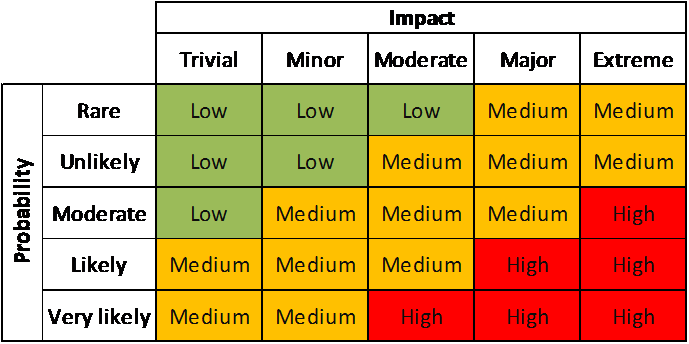
… In which you would have very definite fall-back plans to respond to anything red (high likelihood and high impact), and be aware of the possibility of anything yellow. The stuff in green, can be fairly safely deprioritised to give more space to focus on the more risky stuff.
We have agreed to have some piloted and refined protoypes ready for testing as part of a public half-term offer in the wb. 19th February. So that I can properly arrange this, please can I ask you to complete the doodle poll which can be found at this link…
https://doodle.com/poll/e4aeu3iydrwph5h4
Based on your availability, I will start to put together a schedule for the week (hopefully I can do this quite quickly!).
Note: it’s helpful if you could indicate all the times your are available in the poll – don’t just indicate your preference, it’ll be a nightmare to organise otherwise!
Our second project conference day was a resounding success, and we made loads of progress pinning down the practical commitments for the Oubliette. So, get ready for a long email, which you could do with paying very careful attention to! The headlines here are two dimensions of programme update; firstly, on the mathematical activities we’re basing our rooms on, and the teams who will develop them; secondly, on the underlying organisation and mechanics of the space and the narrative which we will embed it in.
Our main commitment was in creating our final shortlist of mathematical mechanisms which we will then prototype and pilot in sub-teams. These agreed teams were as follows (more info on the mechanisms they reference can be found in this document):
Robyn, Sabeeka, Heena, Chloe, Neave :
Lucy, Jordan, Anna, Maryam and Santiago:
Maaria, Saher, Rebekah and Jade
Sophie, Sanna, Nansin and Paloma
IMPORTANT: If you are not in this list you need to contact me asap with a preference as to which you want to join … there will be a degree of me allocating people, though, to ensure that groups are balanced. I aim to allocate people by Wednesday – so get in touch quickly if you have a preference.
Each team will now work to develop, prototype and pilot a design for their room. I have encouraged groups to do something ‘quick and dirty’ to begin with. Find a cheap and easy way of creating a version of your rooms which can be quickly trialled and refined/re-trialled with friends and family. Ideally, this will happen quite quickly (the next couple of weeks). When you have a bit more confidence in the design of your room, you can work to create a more refined prototype.
Remember, we are aiming to have working prototypes in place by wb 19th February at the very latest so that we can contribute to the half-term EdLab offer.
In support of your prototyping, you may want to draw on two sources of support;
Remember, in designing and prototyping your rooms, we are looking to realise the following qualities:
We have enough money, and technological support, to do quite fancy things with our rooms – so do have an aspirational wishlist of you’d like them to work. At the same time, though, it’d be good to have some fallback plans for simpler versions.
The group were very quickly unanimous that they liked the ‘lost in time’ narrative for the space which was originally proposed by Chloe in the first Saturday session. This approach makes it much easier for us to accommodate the episodic, non-linear experience of players moving around the rooms on a carousel. We agreed a core ‘writing team’ who will meet to take responsibility for the overall narrative. This consisted of Chloe (we assumed you’d want to be part of this), Heena, Robyn and Lucy. These four will also contribute to the room development teams, though they may have to give a little less to make space for the narrative development. Their first task will be to meet to flesh out the overarching story (what greets the players as they arrive to the space?) – and to think carefully about how this would be presented differently to different age groups (I’ll let you decide how many ‘versions’ there will be).
The ‘lost in time’ MacGuffin affords room design teams a degree of creative freedom in how they theme their spaces … we could lurch from the ancient mayans to the distant dystopian future. Room design teams can start to think about this, though I’m going to ask the writing team to take ownership of the balance of the overall narrative so be ready to be flexible and defer to them in terms of theming. We’ll also need to think, of course, about the differentiation of the experience within rooms to accommodate different groups.
I would like to reached final confirmation of the working groups by Wednesday of this week, so please contact me if you aren’t allocated asap.
Ideally, I would then like all groups to have prototyped and piloted something for each of their two rooms in the next two weeks. This can be pretty rough and ready, though, and using friends and family to gain insight. You should also start to form a sense of what your ‘next step’ prototype might look like, and have a chat with James about support with fabrication.
In the same timeframe (i.e. the next two weeks), I’d like the narrative group to have met and be ready to share with everybody else in terms of a bit more detailing of the plot.
Please can I ask for ‘little and often’ blog posts from each team along the way so I can keep track of where we’re up to. At this stage, it’s absolutely fine for one person to take responsibility for a blog update from each meeting, and the others to simply reblog it.
I would like all teams to have produced a summary update blog post on their progress (prototyping and piloting) by 31st January – will reblog these on this main blog so we’re all up to speed
Heena noted how useful it would be for us to visit some escape rooms – so let’s see if we can blag some free trips in exchange for sponsorship. Claire was going to follow up on this with a couple of contacts she has.
Welcome back to university, and the next phase of your EdLab engagement. In the first conference in December, project teams met to begin to generate possible ideas and directions – and you should have sustained this work, with support through your project coordinators blog – since this point. Our next conference will take place this Saturday (13th) between 10 and 3. Through this day, you will start to form some more concrete plans for the development and execution of your projects, set some milestones and establish responsibilities for the delivery of them.
The agenda for the day will take the following structure:
9.45 – Arrival
10.00 – Keynote: The Seven Deadly Sins of Education – Mark Peace (Lecture Theatre 3)
10.45 – Project Workshops
12.00 – Working lunch: During this hour, you should work independently in support of tasks developing your project. In addition, the following workshops are available.
13.00 – Project Workshops (various rooms)
14.30 – Plenary: Briefing on your assessed work (Juliette Wilson Thomas) – LT3
Important: Please make sure that you have undertaken any preparatory tasks for your project ahead of this day.


